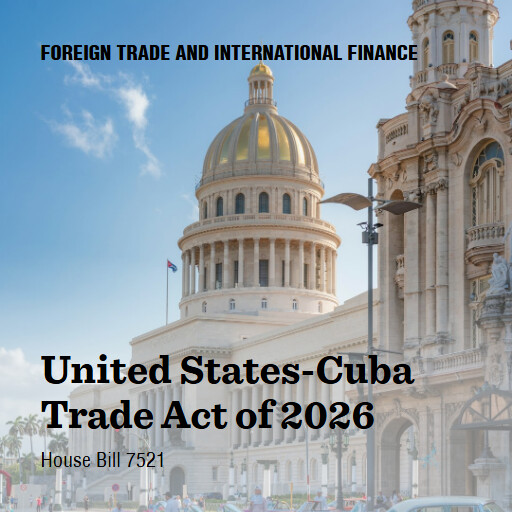
The "United States-Cuba Trade Act of 2026" seeks to lift trade restrictions with Cuba, overturning past laws like the Cuban Democracy Act of 1992 and the Cuban Liberty and Democratic Solidarity Act of 1996. It enables US entities to set up, maintain, and upgrade telecommunications systems in Cuba, and permits travel to and from Cuba, along with related transactions. The bill also prioritizes negotiations on property claims and human rights with Cuba, extends fair trade treatment to Cuban products, and prohibits restrictions on remittances while including measures against money laundering. Additionally, it alters the Internal Revenue Code regarding the reporting and denial of foreign tax credits, affecting US foreign tax policies and international relations.

United States-Cuba Trade Act of 2026
This bill repeals the trade embargo on Cuba and other provisions restricting trade and travel to Cuba.
Specifically, the bill (1) removes restrictions on certain transactions related to trademarks used in connection with a confiscated business or asset, (2) extends nondiscriminatory treatment (i.e., normal trade relations treatment) to Cuban products, and (3) prohibits and rescinds limits on remittances to Cuba.
The bill authorizes common carriers to provide telecommunications services between the United States and Cuba. In addition, travel by U.S. citizens and residents to Cuba may not be regulated or prohibited if such travel would be lawful in the United States.
The President shall take all necessary steps to engage with Cuba to (1) negotiate settlements relating to claims that Cuba had taken the property of U.S. nationals, and (2) secure the protection of internationally recognized human rights. The President may, with respect to Cuba, impose new export controls and exercise powers related to declared national emergencies.
The President must submit a specified determination about a foreign country to Congress prior to denying an income tax credit for taxes paid to the foreign country.