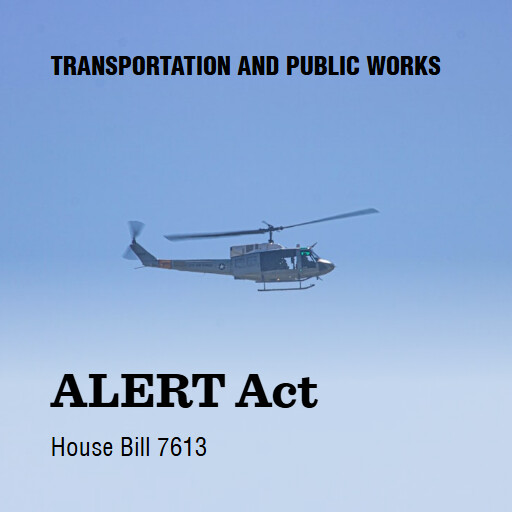
The Airspace Location and Enhanced Risk Transparency Act addresses aviation safety following a mid-air collision. It mandates the upgrade of collision avoidance systems for selected aircraft, establishes a committee to evaluate and issue findings, and requires the installment of collision prevention technology by 2031. The bill aims to improve air traffic controller training, communication frequency, drug testing procedures, and close proximity encounter monitoring. It also focuses on enhancing conflict alert systems, revising helicopter routes, and ensuring safety of military aircraft operating in national airspace. Additionally, the bill mandates the Secretary of Defense to update aircraft manuals and requires transparency regarding a previous midair collision.


Airspace Location and Enhanced Risk Transparency Act of 2026 or the ALERT Act
This bill addresses aviation safety by increasing requirements for aircraft tracking and communication using Automatic Dependent Surveillance-Broadcast (ADS-B) technology and expanding oversight. As background, ADS-B for broadcasting (Out) and receiving (In) transmits information (e.g., location and weather) among aircraft and air traffic control (ATC).
The bill requires the Department of Defense (DOD) and the Department of Transportation (DOT) to enter into an agreement regarding the use of collision prevention technologies on DOD aircraft. The agreement must require the use of ADS-B Out as the default practice for DOD helicopters operating in the national airspace, unless such use would affect operational security. For DOD helicopters that are carrying out special missions in the Washington, DC, metropolitan area and are exempt from ADS-B Out transmission requirements, DOD must coordinate with DOT to conduct a safety risk assessment and implement appropriate mitigations.
By December 31, 2031, DOD aircraft (other than certain special mission aircraft) must be equipped with and operating integrated ADS-B In technology.
With respect to civil aircraft, by December 31, 2031, the Federal Aviation Administration (FAA) must generally require aircraft that are currently required to be equipped with ADS-B Out to also be equipped with ADS-B In.
Additionally, among other requirements, the FAA must
- establish time-on-position limits for supervisory ATC personnel;
- establish a process to timely notify parties involved in certain near-miss incidents; and
- evaluate and revise, as necessary, helicopter routes around Ronald Reagan Washington National Airport.